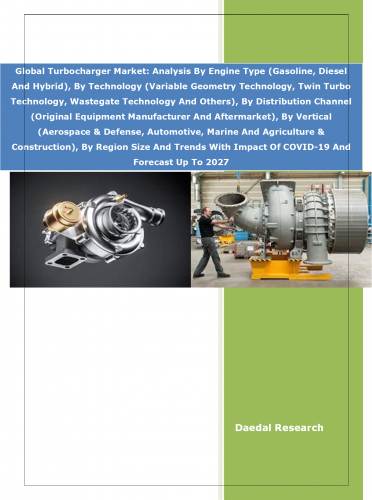
Global Turbocharger Market: Analysis By Engine Type (Gasoline, Diesel And Hybrid), By Technology (Variable Geometry Technology, Twin Turbo Technology, Wastegate Technology And Others), By Distribution Channel (Original Equipment Manufacturer And Aftermarket), By Vertical (Aerospace & Defense, Automotive, Marine And Agriculture & Construction), By Region Size And Trends With Impact Of COVID-19 And Forecast Up To 2027
The global turbocharger market in 2021 was valued at US$16.55 billion. The market value is expected to reach US$24.38 billion by 2027. A turbocharger is a device fitted to a vehicle’s engine that is designed to improve the overall efficiency and increase performance. In a combustion engine, air, fuel and spark combine to create an explosion which creates power to turn the engine.
Turbochargers do not require additional engine power to run as they are driven by exhaust gases that would otherwise go to waste. The engine size can be reduced in a turbocharged engine leading to better packaging, weight saving benefits and overall improved fuel economy. The market is expected to grow at a CAGR of 6.76% during the forecast period of 2022-2027.
Market Segmentation Analysis:
By Engine Type: The report provides the bifurcation of the market into three segments based on the engine type: gasoline, diesel and hybrid. In 2021, gasoline segment held a major share in the market. On the other hand, the hybrid segment is expected to grow at a significant CAGR in the forthcoming years owing to the increasing trend of emission reduction along with increased engine economy.
By Technology: The report provides the bifurcation of the market into four segments based on the technology: Variable geometry technology, twin turbo technology, wastegate technology and others. In 2021, variable geometry technology segment held a major share in the market. This was being followed by twin turbo technology segment. Emission regulations across the globe have generated demand for downsized and down-speeded turbocharging systems for application in small and medium-sized vehicles. This factor has increasingly endorsed the preference for variable geometry technology in turbochargers.
By Distribution Channel: The report provides the bifurcation of the market into two segments based on the distribution channel: original equipment manufacturer and aftermarket. In 2021, original equipment manufacturer segment held a major share in the market. This was being followed by aftermarket segment. Original equipment manufacturers (OEMs) are implementing engine-downsizing tactics to maximize vehicle fuel efficiency as a result of the increasing adoption of rigorous automobile emission standards around the world. The large scale production of vehicles in different categories such as commercial and passenger vehicles with increasing emphasis on fuel efficiency is expected to aid the growth of original equipment manufacturer segment.
By Vertical: The report provides the bifurcation of the market into four segments based on the vertical: aerospace & defense, automotive, marine and agriculture & construction. In 2021, aerospace & defense segment held a major share of in the market. This was being followed by automotive segment. Turbochargers used in aviation increases the density of the intake gas, allowing for more power. Factors such as increase in air passenger traffic across the globe, surge in demand for fuel-efficient and downsized engine and increased public investment in defense aircrafts by nations across the world are expected to propel the aircraft and defense turbocharger market in the coming years.
By Region: The report provides insight into the turbocharger market based on the geographical operations, namely North America, Europe, Asia Pacific, and Latin America, Middle East & Africa (LAMEA). Asia Pacific held the major share in the market, owing to increasing per capita income and stringent government regulations in this region.
Within North America, the US is leading the market, due to increasing awareness about technology and emission regulations. Whereas, in the Europe region, Germany is dominating the market due to strict pollution control rules and restrictions on high emissions.
Market Dynamics:
Growth Drivers: One of the most important factors impacting the global turbocharger market is improved engine performance and improved fuel efficiency. Furthermore, the stringent regulations is driving the turbocharger market. Growing concerns regarding air quality and greenhouse emissions across various regions have compelled manufacturers to focus heavily on technological advancements to control emission from automotive turbochargers as the government authorities have been imposing stringent regulations to curb emissions. Furthermore, the market has been growing over the past few years, due to factors such as rapid urbanization, increased disposable income, increasing penetration of turbochargers in diesel vehicles and many other factors.
Challenges: However, the market has been confronted with some challenges specifically, turbocharger installation & high maintenance costs, etc.
Trends: The market is projected to grow at a fast pace during the forecast period, due to various latest trends such as the increasing adoption of electric turbochargers, rising popularity of variable geometry turbocharging, etc. Emission regulations across the globe have generated demand for downsized and down-speeded turbocharging systems for application in small and medium-sized vehicles. This factor has increasingly endorsed the preference for variable geometry technology in turbochargers Besides, next generation technologies is expected to propel the turbocharger market during forecasted years.
Impact Analysis of COVID-19 and Way Forward:
The novel coronavirus pandemic and the resulting lockdowns have negatively impacted numerous manufacturing and service industries by hampering both the supply-side and demand-side supply chains. The turbocharger market, too, was affected greatly due to the pandemic and lockdowns. The virtual halt on the manufacturing of automobiles during the pandemic drastically brought down the supply of the vehicles, while the travel restrictions brought down the demand for automobiles. This dual shock faced by the automobile industry, in turn, negatively affected the turbocharger market during the pandemic.
Automobile companies have been bearing the brunt of the coronavirus pandemic. New wave in India, China, and the U.K. is compelling stakeholders in the turbocharger market to adopt contingency planning in order to tide over business uncertainties.
Competitive Landscape:
The turbocharger market is consolidated market, where, Honeywell technology, Borgwarner and IHI are major market players.
The key players in the global turbocharger market are:
ABB GroupMondi plc
Cummins Inc.
Eaton Corporation plc
Wabtec Corporation (Precision And Turbo Inc.)
BorgWarner Inc.
Cardone (Rotomaster)
Mitsubishi Heavy Industries Ltd
IHI Corporation
Continental AG
Turbo Dynamics Limited
Honeywell International Inc.
FountainVest Partners (Bosch Mahle Turbo Systems)
Some of the strategies among key players in the market for turbocharger market are mergers, acquisitions, and collaborations. For instance, in 2022, BorgWarner Inc. and Hubei Surpass Sun Electric (SSE) announced that they have entered into an Equity Transfer Agreement under which BorgWarner has agreed to acquire the Electric Vehicle Solution. Whereas, Honeywell International Inc., announced a new, innovative ethanol-to-jet fuel (ETJ) processing technology that allows producers to convert corn-based, cellulosic, or sugar-based ethanol into sustainable aviation fuel (SAF).
Scope of the Report:
The report titled “Global Turbocharger Market: Analysis By Engine Type (Gasoline, Diesel And Hybrid), By Technology (Variable Geometry Technology, Twin Turbo Technology, Wastegate Technology And Others), By Distribution Channel (Original Equipment Manufacturer And Aftermarket), By Vertical (Aerospace & Defense, Automotive, Marine And Agriculture & Construction), By Region Size And Trends With Impact Of COVID-19 And Forecast Up To 2027”, includes :
-- An in-depth analysis of the global by value, by engine type, by vertical, by technology, by distribution channel, by region, etc.
-- The regional analysis of the turbocharger market, including the following regions:
North America (The US, Canada, and Mexico)
Europe (Germany, The UK, France and Rest of the Europe)
Asia Pacific (China, Japan, India, South Korea and Rest of Asia Pacific)
Latin America, Middle East & Africa (LAMEA)
-- Comprehensive information about emerging markets. This report analyses the market for various segments across geographies.
-- Provides an analysis of the COVID-19 impact on the global turbocharger market.
-- Assesses the key opportunities in the market and outlines the factors that are and will be driving the growth of the industry. Growth of the overall the turbocharger market has also been forecasted for the period 2022-2027, taking into consideration the previous growth patterns, the growth drivers, and the current and future trends.
-- Evaluation of the potential role of the turbocharger to improve the market status.
-- Identification of new technological developments, R&D activities, and product launches occuring in the Turbocharger market.
-- In-depth profiling of the key players, including the assessment of the business overview, market strategies, regional and business segments of the leading players in the market.
-- The recent developments, mergers and acquisitions related to mentioned key players are provided in the market report.
-- The in-depth analysis provides an insight into the market, underlining the growth rate and opportunities offered in the business.
Tags :
1. Executive Summary
2. Introduction
2.1 Turbocharger: An Overview
2.1.1 Definition of Turbocharger
2.2 Turbocharger Segmentation: An Overview
2.2.1 Turbocharger Segmentation
3. Global Market Analysis
3.1 Global Turbocharger Market: An Analysis
3.1.1 Global Turbocharger Market: An Overview
3.1.2 Global Turbocharger Market by Value
3.1.3 Global Turbocharger Market by Engine Type (Gasoline, Diesel And Hybrid)
3.1.4 Global Turbocharger Market by Technology (Variable Geometry Technology, Twin Turbo Technology, Wastegate Technology And Others)
3.1.5 Global Turbocharger Market by Distribution Channel (Original Equipment Manufacturer And Aftermarket)
3.1.6 Global Turbocharger Market by Vertical (Aerospace & Defense, Automotive, Marine And Agriculture & Construction)
3.1.7 Global Turbocharger Market by Region (Asia Pacific, North America, Europe and LAMEA)
3.2 Global Turbocharger Market: Engine Type Analysis
3.2.1 Global Turbocharger Market by Engine Type : An Overview
3.2.2 Global Gasoline Turbocharger Market by Value
3.2.3 Global Diesel Turbocharger Market by Value
3.2.4 Global Hybrid Turbocharger Market by Value
3.3 Global Turbocharger Market: Technology Analysis
3.3.1 Global Turbocharger Market By Technology: An Overview
3.3.2 Global Variable Geometry Technology Turbocharger Market By Value
3.3.3 Global Twin Turbo Technology Turbocharger Market By Value
3.3.4 Global Wastegate Technology Turbocharger Market By Value
3.3.5 Global Others Technology Turbocharger Market By Value
3.4 Global Turbocharger Market: Distribution Channel Analysis
3.4.1 Global Turbocharger Market By Distribution Channel: An Overview
3.4.2 Global Turbocharger Original Equipment Manufacturer Market By Value
3.4.3 Global Turbocharger Aftermarket Market By Value
3.5 Global Turbocharger Market: Vertical Analysis
3.5.1 Global Turbocharger Market By Vertical: An Overview
3.5.2 Global Aerospace Turbocharger Market By Value
3.5.3 Global Automotive Turbocharger Market By Value
3.5.4 Global Marine Turbocharger Market By Value
3.5.5 Global Agriculture & Construction Turbocharger Market By Value
4. Regional Market Analysis
4.1 Asia Pacific Turbocharger Market: An Analysis
4.1.1 Asia Pacific Turbocharger Market: An Overview
4.1.2 Asia Pacific Turbocharger Market by Value
4.1.3 Asia Pacific Turbocharger Market by Region (China, Japan, India, South Korea and Rest of Asia Pacific)
4.1.4 China Turbocharger Market by Value
4.1.5 Japan Turbocharger Market by Value
4.1.6 India Turbocharger Market by Value
4.1.7 South Korea Turbocharger Market by Value
4.1.8 Rest of Asia Pacific Turbocharger Market by Value
4.2 North America Turbocharger Market: An Analysis
4.2.1 North America Turbocharger Market: An Overview
4.2.2 North America Turbocharger Market by Value
4.2.3 North America Turbocharger Market by Region (The US, Mexico, and Canada)
4.2.4 The US Turbocharger Market by Value
4.2.5 Canada Turbocharger Market by Value
4.2.6 Mexico Turbocharger Market by Value
4.3 Europe Turbocharger Market: An Analysis
4.3.1 Europe Turbocharger Market: An Overview
4.3.2 Europe Turbocharger Market by Value
4.3.3 Europe Turbocharger Market by Region (UK, Germany, France and Rest of Europe)
4.3.4 Germany Turbocharger Market by Value
4.3.5 United Kingdom Turbocharger Market by Value
4.3.6 France Turbocharger Market by Value
4.3.7 Rest of Europe Turbocharger Market by Value
4.4 LAMEA Turbocharger Market: An Analysis
4.4.1 LAMEA Turbocharger Market: An Overview
4.4.2 LAMEA Turbocharger Market by Value
5. Impact of COVID-19
5.1 Impact of COVID-19
5.1.1 Impact of COVID-19 on Turbocharger Market
5.1.2 Impact of COVID-19 on Motor Vehicle Production
5.1.3 Post COVID-19 Impact on Turbocharger Market
6. Market Dynamics
6.1 Growth Drivers
6.1.1 Increasing Per Capita Income
6.1.2 Rapid Urbanization
6.1.3 Improved Engine Performance
6.1.4 Improved Fuel Efficiency
6.1.5 Increasing Penetration of Turbochargers in Diesel Vehicles
6.1.6 Stringent Regulations
6.2 Challenges
6.2.1 Turbocharger Installation & High Maintenance Costs
6.3 Market Trends
6.3.1 Variable Geometry Turbocharging
6.3.2 Next Generation Technologies
6.3.3 Increasing Adoption of Electric Turbochargers