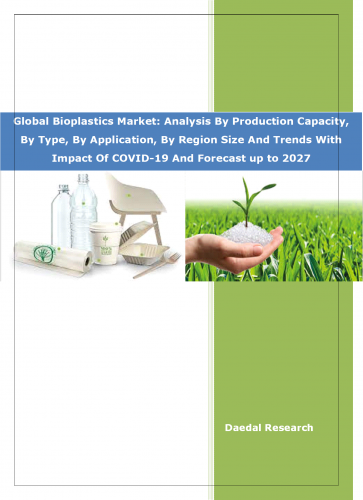
Global Bioplastics Market: Analysis By Production Capacity, By Type, By Application, By Region Size And Trends With Impact Of COVID-19 And Forecast up to 2027
The global bioplastics market was valued at US$8.14 billion in 2021. The market value is expected to reach US$18.05 billion by 2027. Plastics made from renewable biomass sources, such as plant fats and oils, maize starch, straw, woodchips, sawdust, and recovered food waste, are known as bioplastics. Plastic material is defined as bioplastics if it is either bio-based, biodegradable, or features both properties.
While global plastic production has edged down, the market for bioplastics has continued to grow. Moreover, the growing demand for bioplastics in the medical sector, technological advancements, and increasing research and development would drive market growth. The market is expected to grow at a CAGR of approx. 14% during the forecasted period of 2022-2027.
Market Segmentation Analysis:
By Type: The report provides the bifurcation of the market into two segments based on type: Biodegradable, and Non-Biodegradable. In terms of value and production capacity, the biodegradable segment held the highest share of the market. The biodegradable segment’s production capacity has been further analyzed based on type: PLA, Starch blends, PBAT, PHA, and Others. Similarly, the non-biodegradable segment’s production capacity has been also analyzed based on the following types: PTT, PE, PA, PET, PP, and Other. Polylactic acid (PLA) is among the world’s most widely used bioplastics, which are plastics derived from renewable inputs and/or are biodegradable.
By Application: The report further provides the bifurcation based on the application: Flexible Packaging, Rigid Packaging, Textiles, Consumer Goods, Agriculture & Horticulture, Coating & Adhesives, and Others. The flexible packaging segment held the highest share of the market owing to its high efficiency and cost-effective nature. In terms of production capacity, the agriculture & horticulture segmnet is expected to be the fastest growing in the upcoming years.
By Region: The report provides insight into the bioplastics market based on the regions namely Asia Pacific, Europe, North America, and the Rest of the World. Asia Pacific held the highest share in the market and over the years, the Asia Pacific bioplastics market has grown at a fast pace due to the increasing demand from the packaging industry, coupled with favorable government regulations. In terms of value and production capacity, China held the highest share in the market owing to the high per capita consumption, increasing consumer preference for bio-based products over synthetic products, and increase in government initiatives.
Germany is one of the major economies in Europe, and the bioplastics market has grown at the fastest rate in the country. Germany already supports the use of certified bio-based and compostable bio waste plastic bags for the collection of bio waste in the Bio waste Ordinance. Since 2015, a separate collection of bio waste is mandatory in Germany.
The Government of Canada continues to encourage alternatives to plastic waste. They are working towards eliminating the unnecessary use of single-use plastics in government operations, meetings, and events, and purchasing more sustainable plastic products that can be reused, repaired, or repurposed.
Market Dynamics:
Growth Drivers: The global bioplastics market growth is predicted to be supported by numerous growth drivers such as increasing fossil fuel prices, increasing demand for eco-friendly goods, emergence of bio-based and renewable raw materials, high consumer acceptance for bioplastics, growing beverage packaging industry, favorable government initiatives, reduced greenhouse gas emissions, and many other factors. The need for eco-friendly substitutes for conventional goods and packaging is higher than ever as more people become mindful customers. Businesses are changing to meet the demands of environmentally concerned customers and transitioning to green packaging options, not merely for the sake of the environment but also to keep customers. Bio-based plastics have better material qualities and a smaller carbon footprint than fossil-based plastics. Thus, a shift in consumer attitudes and behavior has contributed to the rise in demand for eco-friendly products and packaging.
Challenges: However, the market growth would be negatively impacted by various challenges such as high cost of product, limited regulations related to bioplastics in developing countries, etc.
Trends: The market is projected to grow at a fast pace during the forecast period, due to various latest trends such as increasing demand for electronic vehicles, growing demand of bioplastics in medical sector, technological advancements, increasing research and development, etc. The future and benefits of reduced vehicle weight are largely dependent on choosing the most resource-efficient plastics. Bio-based plastics contribute to lowering the environmental impact of vehicle production by reducing energy usage as well as CO2 emissions. Materials like PTFE and biopolyimide have proven highly effective as insulators in high-voltage-high-temperature applications. Therefore, the increasing demand for electronic vehicles would increase the bioplastics market.
Impact Analysis of COVID-19 and Way Forward:
In 2020, global bioplastics have experienced negative growth. Numerous multinational corporations made commitments to use biodegradable plastics in response to consumer and activist pressure before the COVID-19 pandemic. However, after the COVID-19 outbreak, the regulations on single-use plastics and green investments announced by many governments and organizations got postponed due to the pandemic, resulting in a reduction in the uptake of bio-based alternatives. However, as the lockdown eased, the market witnessed significant growth. Moreover, as people become more aware of the expanding plastic waste stream and its effects on the environment, the private and public sectors are anticipated to invest more funding to speed up the use of bioplastics.
Competitive Landscape:
The global bioplastics market is consolidated. The key players in the global bioplastics market are:
Avantium N.V.
BASF SE
Toray Industries Inc.
Eastman Chemical Company
Biome Technologies PLC
Carbion N.V.
Kuraray Co., Ltd (Plantic Technologies Ltd.)
Mitsubishi Chemical Group
Novamont S.p.A.
Futerro, NatureWorks LLC
PTT MCC Biochem Co. Ltd.
Some of the strategies among key players in the market are mergers, acquisitions, and collaborations. For instance, in 2022, Avantium N.V. announced that the company’s business unit Avantium Catalysis would expand the company’s business to focus increasingly on R&D solutions for sustainable chemistry. On the other hand, Toray Industries, Inc., announced that the company has developed a polyethylene terephthalate (PET) film that combines excellent applicability and adhesion for water-based and solvent-free coatings and can eliminate solvent-derived carbon-dioxide emissions. In the global bioplastics market, TEIJIN Limited held the major share of the market, followed by BASF SE and SABIC.
Scope of the Report:
The report titled “Global Bioplastics Market: Analysis By Production Capacity, By Type, By Application, By Region Size And Trends With Impact Of COVID-19 And Forecast up to 2027”, includes :
-- An in-depth analysis of the global bioplastics market by value, by production capacity, by type, by application, by region, etc.
-- The regional analysis of the bioplastics market, including the following regions:
Asia Pacific (China, Japan, India, and Rest of Asia Pacific)
Europe (Germany, France, UK, and Rest of Europe)
North America (The US, Canada, and Mexico)
Rest of the World
-- Comprehensive information about emerging markets. This report analyses the market for various segments across geographies.
-- Provides an analysis of the COVID-19 impact on the global bioplastics market.
-- Assesses the key opportunities in the market and outlines the factors that are and will be driving the growth of the industry. Growth of the overall the bioplastics market has also been forecasted for the period 2022-2027, taking into consideration the previous growth patterns, the growth drivers, and the current and future trends.
-- Evaluation of the potential role of the bioplastics to improve the market status.
-- Identification of new technological developments, R&D activities, and product launches occuring in the bioplastics market.
-- In-depth profiling of the key players, including the assessment of the business overview, market strategies, regional and business segments of the leading players in the market.
-- The recent developments, mergers and acquisitions related to mentioned key players are provided in the market report.
-- The in-depth analysis provides an insight into the market, underlining the growth rate and opportunities offered in the business.
Tags :
1. Executive Summary
2. Introduction
2.1 Bioplastics: An Overview
2.1.1 Introduction to Bioplastics
2.1.2 Advantages of Bioplastics
2.2 Bioplastics Segmentation: An Analysis
2.2.1 Bioplastics Segmentation
3. Global Market Analysis
3.1 Global Bioplastics Market: An Analysis
3.1.1 Global Bioplastics Market: An Overview
3.1.2 Global Bioplastics Market by Value
3.1.3 Global Bioplastics Market by Type (Biodegradable, and Non-Biodegradable)
3.1.4 Global Bioplastics Market by Application (Flexible Packaging, Rigid Packaging, Textiles, Consumer Goods, Agriculture & Horticulture, Coating & Adhesives, and Others)
3.1.5 Global Bioplastics Market by Region (Asia Pacific, Europe, North America, and the Rest of the World)
3.2 Global Bioplastics Market: Production Capacity Analysis
3.2.1 Global Bioplastics Market by Production Capacity: An Overview
3.2.2 Global Bioplastics Market by Production Capacity
3.2.3 Global Bioplastics Market Production Capacity by Type (Biodegradable, and Non-Biodegradable)
3.2.4 Global Bioplastics Market Production Capacity by Application (Flexible Packaging, Rigid Packaging, Consumer Goods, Textiles, Agriculture & Horticulture, Coating & Adhesives, and Other)
3.2.5 Global Bioplastics Market Production Capacity by Region (Asia Pacific, Europe, North America, and Rest of the World)
3.3 Global Bioplastics Market: Type Analysis
3.3.1 Global Bioplastics Market by Type: An Overview
3.3.2 Global Biodegradable Bioplastics Market by Value
3.3.3 Global Biodegradable Bioplastics Market by Production Capacity
3.3.4 Global Biodegradable Bioplastics Market Production Capacity by Type (Polylactic acid (PLA), Starch blends, poly(butylene adipate-co-terephthalate) (PBAT), and Polyhydroxyalkanoates (PHAs), and Other)
3.3.5 Global Biodegradable Bioplastics Market Type by Production Capacity
3.3.6 Global Non-Biodegradable Bioplastics Market by Value
3.3.7 Global Non-Biodegradable Bioplastics Market by Production Capacity
3.3.8 Global Non-Biodegradable Bioplastics Market Production Capacity by Type (Poly Trimethylene Terephthalate (PTT), Polyethylene (PE), Polyamide (PA), Polyethylene-Terephthalate (PET), Polypropylene (PP), and Other)
3.3.9 Global Non-Biodegradable Bioplastics Market Type by Production Capacity
3.4 Global Bioplastics Market: Application Analysis
3.4.1 Global Bioplastics Market by Application: An Overview
3.4.2 Global Flexible Packaging Bioplastics Market by Value
3.4.3 Global Flexible Packaging Bioplastics Market by Production Capacity
3.4.4 Global Rigid Packaging Bioplastics Market by Value
3.4.5 Global Rigid Packaging Bioplastics Market by Production Capacity
3.4.6 Global Textiles Bioplastics Market by Value
3.4.7 Global Textiles Bioplastics Market by Production Capacity
3.4.8 Global Consumer Goods Bioplastics Market by Value
3.4.9 Global Consumer Goods Bioplastics Market by Production Capacity
3.4.10 Global Agriculture & Horticulture Bioplastics Market by Value
3.4.11 Global Agriculture & Horticulture Bioplastics Market by Production Capacity
3.4.12 Global Coating & Adhesives Bioplastics Market by Value
3.4.13 Global Coating & Adhesives Bioplastics Market by Production Capacity
3.4.14 Global Other Bioplastics Market by Value
3.4.15 Global Other Bioplastics Market by Production Capacity
4. Regional Market Analysis
4.1 Asia Pacific Bioplastics Market: An Analysis
4.1.1 Asia Pacific Bioplastics Market: An Overview
4.1.2 Asia Pacific Bioplastics Market by Value
4.1.3 Asia Pacific Bioplastics Market Value by Region (China, Japan, India, and the Rest of Asia Pacific)
4.1.4 Asia Pacific Bioplastics Market by Production Capacity
4.1.5 Asia Pacific Bioplastics Market Production Capacity by Region (China, Japan, India, and the Rest of Asia Pacific)
4.1.6 China Bioplastics Market by Value
4.1.7 China Bioplastics Market by Production Capacity
4.1.8 Japan Bioplastics Market by Value
4.1.9 Japan Bioplastics Market by Production Capacity
4.1.10 India Bioplastics Market by Value
4.1.11 India Bioplastics Market by Production Capacity
4.1.12 Rest of Asia Pacific Bioplastics Market by Value
4.1.13 Rest of Asia Pacific Bioplastics Market by Production Capacity
4.2 Europe Bioplastics Market: An Analysis
4.2.1 Europe Bioplastics Market: An Overview
4.2.2 Europe Bioplastics Market by Value
4.2.3 Europe Bioplastics Market Value by Region (Germany, France, UK, and the Rest of Europe)
4.2.4 Europe Bioplastics Market by Production Capacity
4.2.5 Europe Bioplastics Market Production Capacity by Region (Germany, France, UK, and the Rest of Europe)
4.2.6 Germany Bioplastics Market by Value
4.2.7 Germany Bioplastics Market by Production Capacity
4.2.8 France Bioplastics Market by Value
4.2.9 France Bioplastics Market by Production Capacity
4.2.10 UK Bioplastics Market by Value
4.2.11 UK Bioplastics Market by Production Capacity
4.2.12 Rest of Europe Bioplastics Market by Value
4.2.13 Rest of Europe Bioplastics Market by Production Capacity
4.3 North America Bioplastics Market: An Analysis
4.3.1 North America Bioplastics Market: An Overview
4.3.2 North America Bioplastics Market by Value
4.3.3 North America Bioplastics Market Value by Region (The US, Canada, and Mexico)
4.3.4 North America Bioplastics Market by Production Capacity
4.3.5 North America Bioplastics Market Production Capacity by Region (The US, Canada, and Mexico)
4.3.6 The US Bioplastics Market by Value
4.3.7 The US Bioplastics Market by Production Capacity
4.3.8 Canada Bioplastics Market by Value
4.3.9 Canada Bioplastics Market by Production Capacity
4.3.10 Mexico Bioplastics Market by Value
4.3.11 Mexico Bioplastics Market by Production Capacity
4.4 Rest of the World Bioplastics Market: An Analysis
4.4.1 Rest of the World Bioplastics Market: An Overview
4.4.2 Rest of the World Bioplastics Market by Value
4.4.3 Rest of the World Bioplastics Market by Production Capacity
5. Impact of COVID-19
5.1 Impact of COVID-19 on Bioplastics Market
5.2 Post COVID-19 Impact on Bioplastics Market
6. Market Dynamics
6.1 Growth Drivers
6.1.1 Increasing Fossil Fuel Prices
6.1.2 Increasing Demand for Eco-Friendly Goods
6.1.3 Emergence of Bio-based and Renewable Raw Materials
6.1.4 High Consumer Acceptance for Bioplastics
6.1.5 Growing Beverage Packaging Industry
6.1.6 Favorable Government Initiatives
6.1.7 Reduced Greenhouse Gas Emissions
6.2 Challenges
6.2.1 High Cost Associated
6.2.2 Limited Regulations Related to Bioplastics in Developing Countries
6.3 Market Trends
6.3.1 Increasing Demand for Electronic vehicles
6.3.2 Growing Demand of Bioplastics in Medical Sector
6.3.3 Technological Advancements
6.3.4 Increasing Research and Development
7. Competitive Landscape
7.1 Global Bioplastics Key Players by Market Share
8. Company Profiles
8.1 Avantium N.V.
8.1.1 Business Overview
8.1.2 Operating Segments
8.1.3 Business Strategy
8.2 BASF SE
8.2.1 Business Overview
8.2.2 Operating Segments
8.2.3 Business Strategy
8.3 Toray Industries Inc.
8.3.1 Business Overview
8.3.2 Operating Segments
8.3.3 Business Strategy
8.4 Eastman Chemical Company
8.4.1 Business Overview
8.4.2 Operating Segments
8.4.3 Business Strategy
8.5 Biome Technologies PLC
8.5.1 Business Overview
8.5.2 Operating Segments
8.5.3 Business Strategy
8.6 Carbion N.V.
8.6.1 Business Overview
8.6.2 Net Sales by Business Area
8.6.3 Business Strategy
8.7 Kuraray Co., Ltd (Plantic Technologies Ltd.)
8.7.1 Business Overview
8.7.2 Operating Segments
8.7.3 Business Strategy
8.8 Mitsubishi Chemical Group
8.8.1 Business Overview
8.8.2 Operating Segments
8.8.3 Business Strategy
8.9 Novamont S.p.A.
8.9.1 Business Overview
8.9.2 Business Strategy
8.10 Futerro
8.10.1 Business Overview
8.10.2 Business Strategy
8.11 NatureWorks LLC
8.11.1 Business Overview
8.11.2 Business Strategy
8.12 PTT MCC Biochem Co. Ltd
8.12.1 Business Overview
8.12.2 Business Strategy